

The art for the summer season in The Vine Bistro at Glenelly Estate features three contemporary artists who all have connections to Stellenbosch. Titled Ebb and flow , the exhibition opened on 6 November 2025.
Nicolette von Wiese’s fine works using thread, one of which is the inspiration for the exhibition’s title, are “meditations on memories,” both playful and reflective.
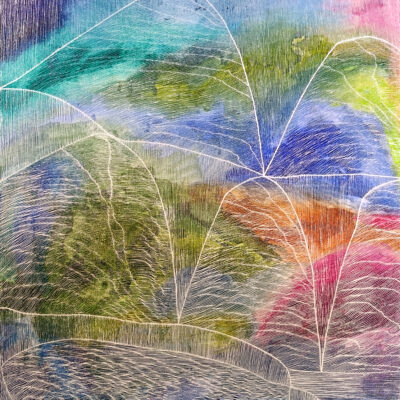
Ruth Le Roux’s richly-coloured landscapes become real as she works spontaneously in paint, conjuring worlds other than the one she’s in. Her paintings emerge, evocative of our world, while simultaneously they convey expressions of her feelings.
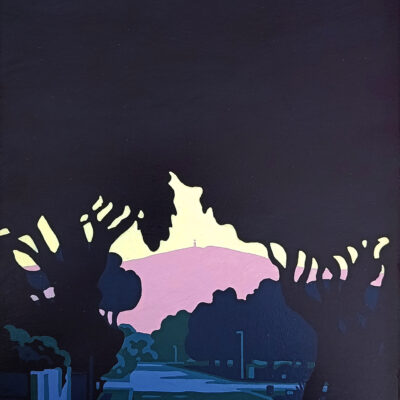
Jean de Wet’s paintings, in which his experienced eye for observing detail and light, distils the time of day into alluring natural scenes. As viewers we feel drawn to become the people present in these spaces.

The artists Nicolette von Wiese, Ruth Le Roux, Jean de Wet and curator Julia Meintjes

Nicolette von Wiese
Hopscotch 1 (detail)

Ruth Le Roux
The things they’ve seen

Jean de Wet
Turning around
Ruth Le Roux
Ruth Le Roux’s connection to nature began in childhood, hiking alone in the mountains of Stellenbosch, though the mountains she paints are not tied to a single place. They evoke a kind of everywhere and nowhere. Her early interest in woodcut techniques, which developed during high school, still resonates in the carved quality of her mark-making.
Jean de Wet
Jean de Wet, by contrast, depicts real, specific places in his work and there is a real “thrill when people recognise the place!”
For years, he walked everywhere: for pleasure, to explore the city, but also when running errands. One tends to notice a lot more as a pedestrian, seeing the city at eye-level and not having to focus on the road or traffic. Furthermore, the same route changes with the light at different times of day and at different times of the year.
Meandering through streets, paths and parks, the series [of paintings] focuses on both graphic abstraction and amusing moments of light.”
De Wet works with a restrained palette: with only a single shade of red, blue and yellow, he mixes all the colours and hues from there. The specific primary hues he uses may change from series to series, which means the ‘recipes’ and approach to mixing colours must be discovered anew. The darkest shadows in Lower Plein Street, for example, are really quite purple.
The restricted colour palette and abstracted shapes which make up the landscapes are imposed limitations which inform his process:
“Limitations force creativity, but also make solutions easier to find since you’re restrained in your options”
Nicolette von Wiese
Continuing the theme of the exhibition, Nicolette von Wiese conceives of her work as landscapes, and “the slow, deliberate act of stitching mirrors the journey itself – each stitch marking time, endurance, and reflection.”
Ebb and flow, a work in thread on linen and lends its title to the exhibition, maintains a fluidity and lightness. Whereas the works Hopscotch 1 and Hopscotch 2 began with a rigid, planned, repetitive grid, mapped onto old papers and document covers found among family records. Thereupon, the colour and detail unfold organically, guided by the materials. The process feels like “a walk through familiar, forgotten, or imagined memories”.
“I’m drawn to repurposed and aged materials because they carry a sense of history and quiet depth. Their worn surfaces show traces of time, use, and human touch – things that bring a richness that new materials simply don’t have. When I work with something that’s already had another life, it feels like I’m continuing its story, rather than starting a new one. Reusing materials is also about valuing what already exists; acknowledging that beauty and meaning often live in the things we tend to overlook or discard.”


Willem Snyman’s plein air descriptive painting of Table Mountain has been included on the exhibition as a contrast to the more reflective ‘landscape’ depictions by Jean de Wet, Ruth Le Roux and Nicolette von Wiese.

Willem Snyman – Table mountain (oil on canvas)
View all the works in the exhibition below: click on a thumbnail to give you details about the work.
Visit the exhibition in person at The Vine Bistro, Glenelly Estate, Lelie Street, Ida’s Valley, Stellenbosch. Lunch bookings from Tuesday to Sunday, and dinner bookings on Fridays and Saturdays available through Dineplan.
For more details about the art, contact us on info@juliameintjes.co.za or 083 969 6926 (calls or Whatsapp)

Paintings

Paintings

Textiles

Paintings

Mixed media on paper

Mixed media on paper

Paintings

Paintings
Paintings

Paintings

Paintings

Paintings

Paintings

Paintings

Paintings
Paintings

Paintings